

Risk management
PURPOSE:
QLeave recognises that effective risk management is an integral part of sustainable business operations. QLeave supports a positive risk management culture that contributes to strengthening governance by applying a consistent approach to risk management. QLeave’s risk management approach supports decision-making at strategic, operational and project levels to ensure that expenditure and decisions are evidence-based and support the strategic direction and objectives of QLeave.
ENTERPRISE RISK MANAGEMENT FRAMEWORK AND REPORTING:
QLeave manages risks by involving all business units to identify risks, and record mitigation actions in a central material risk register for implementation by the appropriate areas. The register is reviewed by all managers and QLeave executive directors and directors. Regular reports are provided to the Finance, Audit and Risk Management (FARM) Committee and the Boards.
QLeave embedded an Enterprise Risk Management Framework, tailored risk assessment tools, and the Risk Management Policy and Procedure. Steps are taken to reinforce risk management awareness and capability through dedicated training, engagement, a Risk Officers Network, and streamlined quarterly risk review processes. Our Enterprise Risk Management Framework is aligned with the following legislation, standards and best practice guides:
- Financial Accountability Act 2009
- Financial and Performance Management Standard 2019
- Queensland Treasury - Financial Accountability Handbook
- AS/NZS ISO 31000:2018 Risk management – Principles and Guidelines
- Prudential Standard SPS 220 Risk Management
- Queensland Treasury - A Guide to Risk Management.
MATERIAL RISK:
As part of the enhanced Enterprise Risk Management Framework, QLeave adopted the concept of ‘material risk’ from the Prudential Standard SPS 220. Material risks are those that may have a material impact (i.e. a significant impact) on our operations and the ability to meet our obligations. This strategic approach allows QLeave to capture both strategic and operational material risks on one material risk register – which enables us to focus time, effort and resources on risks that pose the most significant threat to the agency.
RISK MANAGEMENT PROCESS:
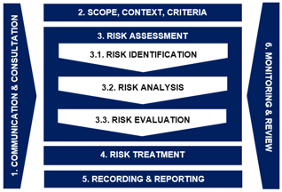
The risk management process is an integral part of management and decision-making processes at QLeave. QLeave’s risk management process aligns with the below diagram from AS/NZS ISO 31000:2018 Risk Management Guidelines:
RESPONSIBILITIES:
Everyone in QLeave is responsible for contributing to the effectiveness of risk management for the agency.
- The General Manager is responsible for the oversight of risk management at QLeave. This includes ensuring risk management practices are compliant with the relevant standards, material risks are being managed appropriately and risks are being reported quarterly to the FARM Committee and the Boards.
- Executive Directors and Directors are responsible for the oversight of controls and key management actions to reduce material risks for the agency, providing strategic advice to the General Manager on emerging material risks that could impact the achievement of the agency’s objectives or business operations and ensuring a positive, risk-aware culture exists across the agency.
- Directors and Managers are responsible for providing quarterly updates on material risks for which they are responsible, maintaining controls and implementing key management actions to effectively mitigate material risk.
- Employees are responsible for identifying risks that may impact their ability to undertake their duties and escalating any potential risks to their supervisor or manager.
MONITORING AND REVIEW:
Continuous monitoring and review are vital parts of the risk management process. All QLeave material risks (strategic and operational categories) are reviewed quarterly to ensure they remain relevant and are being appropriately managed. Changes in the internal and external environment, effectiveness of existing controls and progress against the implementation of key management actions are taken into consideration when assessing quarterly risk ratings. The process of monitoring and review also includes identifying and documenting new or emerging risks by considering both the internal and external environmental impacts on QLeave’s operations and ability to meet strategic objectives.